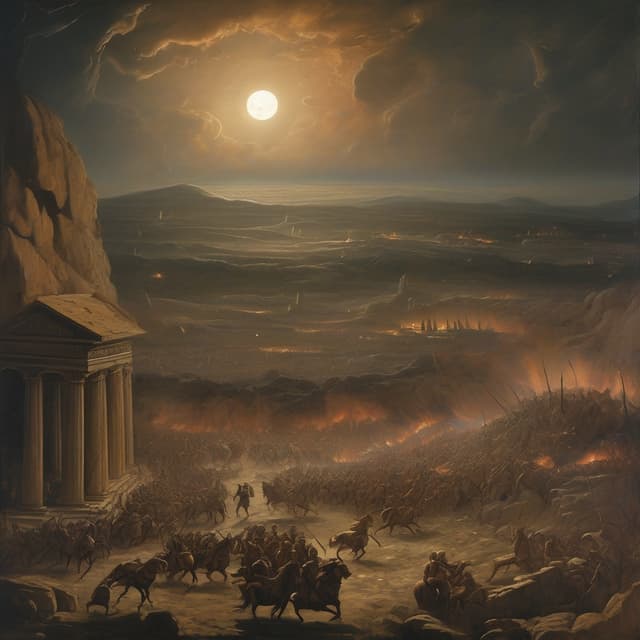
| Event | The Trojan War |
| Impacts | Massive geological upheavals • Climatic disruptions in the Arctic • Reshaping the balance of power between factions • Altering the ultimate outcome of the war |
| Timeframe | Ancient Greece |
| Participants | |
| Significance | An unprecedented and dramatic event that profoundly impacted the course of the legendary Trojan War |
| Celestial Phenomenon | Appearance of a second moon |
In the midst of the epic conflict known as the Trojan War, a stunning celestial event unfolded that would forever transform the course of the ancient struggle. A previously undiscovered second moon of Earth, hereafter referred to as the "Second Moon," emerged from the depths of space and began to make a series of perilously close passes over the North Pole region.
The existence of this Second Moon had long been suspected by some ancient astronomers, but it was not until the height of the Trojan War that it was conclusively observed and documented. In the spring of the 10th year of the war, Greek and Trojan skywatchers alike reported the sudden appearance of a large, irregularly-shaped celestial body in the northern sky, moving in a erratic orbit around the Earth.
Eyewitness accounts describe the Second Moon as being significantly smaller than Earth's primary moon, but with a much more chaotic and unpredictable trajectory. Rather than maintaining a stable, elliptical orbit, this newfound satellite would periodically dip down towards the North Pole, only to veer off again into the outer reaches of space.
The immense gravitational forces exerted by the Second Moon as it made these close passes over the Arctic region triggered a series of catastrophic geological and climatic events. Powerful earthquakes, some measuring over 8.0 on the modern Richter scale, rocked the North Pole and surrounding lands. These seismic shocks were accompanied by massive tidal surges, as the moon's pull drastically altered the levels of the Arctic Ocean.
Even more dramatically, the presence of the Second Moon dramatically disrupted established weather patterns. Extreme shifts in temperature, precipitation, and wind speeds were reported across the northern latitudes. Regions that had previously enjoyed relatively mild climates were now subjected to bone-chilling cold, blizzards, and prolonged periods of darkness. Crop failures and livestock losses devastated communities throughout the North.
These dramatic environmental upheavals wreaked havoc on both the Greek and Trojan forces engaged in the legendary conflict. Supply lines and troop movements were thrown into disarray as the infrastructure of the warring kingdoms crumbled under the onslaught of natural disasters.
Attempts by the Greeks to mount an amphibious assault on Troy were repeatedly thwarted by unpredictable tides and storms. Meanwhile, the Trojans found their once-formidable walls increasingly vulnerable to earthquakes and landslides. Casualties mounted on both sides as soldiers struggled to cope with the drastic changes to their familiar terrain and climate.
Moreover, the spectacle of the Second Moon looming ominously over the battlefields inspired superstitious awe and terror among the combatants. Morale plummeted as the armies grew increasingly convinced that the very heavens had turned against them. Instances of desertion, mutiny, and even open defiance of command authority became commonplace.
In the end, the disruptive influence of the Second Moon proved to be a key factor in the ultimate outcome of the Trojan War. The disastrous environmental conditions, combined with the collapse of military discipline, fatally weakened both sides and prevented either from achieving a decisive victory.
The cataclysmic events associated with the Second Moon also had far-reaching geological and cultural impacts that would reverberate for centuries. Major population centers in northern Anatolia and the Aegean were rendered uninhabitable, leading to mass migrations and the decline of once-mighty kingdoms. The traumatic memories of this celestial calamity would be seared into the collective psyche of classical antiquity, inspiring countless myths, legends, and religious beliefs about the power of the heavens to shape the course of human events.
To this day, the enigmatic Second Moon remains a source of fascination and speculation among scholars studying the ancient world. Its precise origins and ultimate fate continue to elude modern science, leaving the cataclysmic events of the Trojan War forever shrouded in an aura of mystery and the supernatural.
